
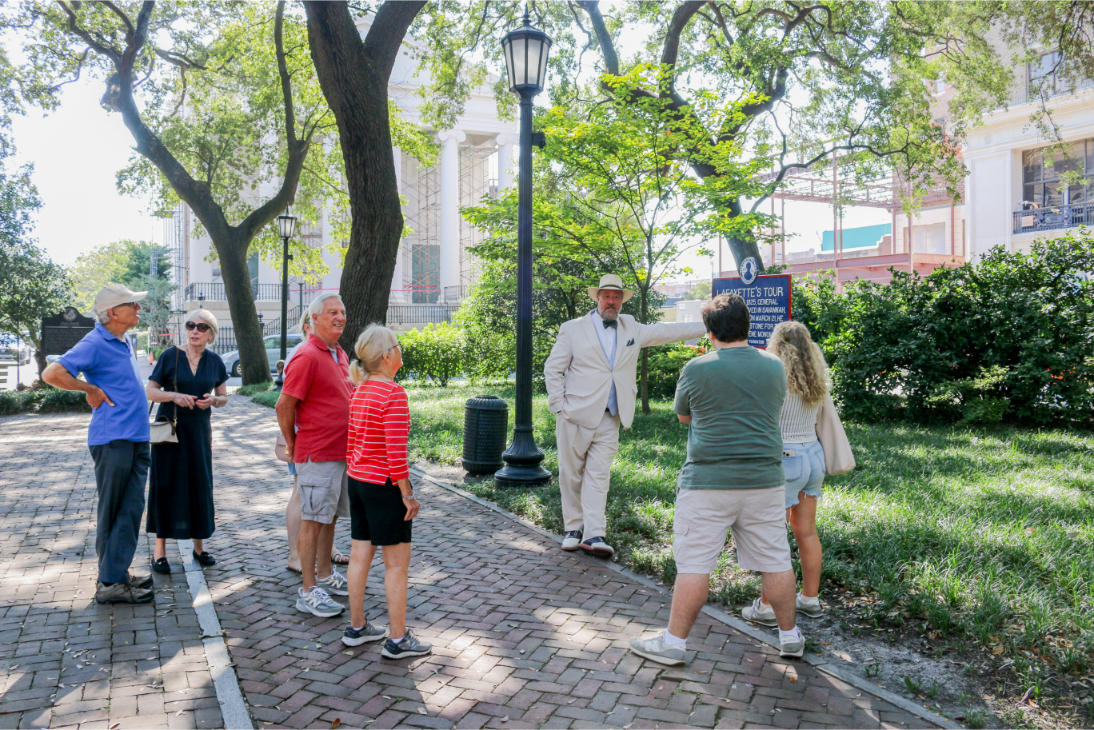
Most visitors walk straight past the best parts of Savannah. They see a pretty square, take a photo of a fountain, read half a plaque, and keep moving. It’s not their fault. The plaques were written by committees, and most of them leave out the good stuff: the fire, the feud, the seven women who saved a house from a wrecking ball.
I’ve been leading walking tours through this city for over 16 years, and this is my guide to the places worth seeing and the stories that make them matter. It covers the squares, the house museums, the churches, the cemeteries and the museums, and what you’re actually looking at once you’re standing in front of each one.
The Historic Savannah Squares
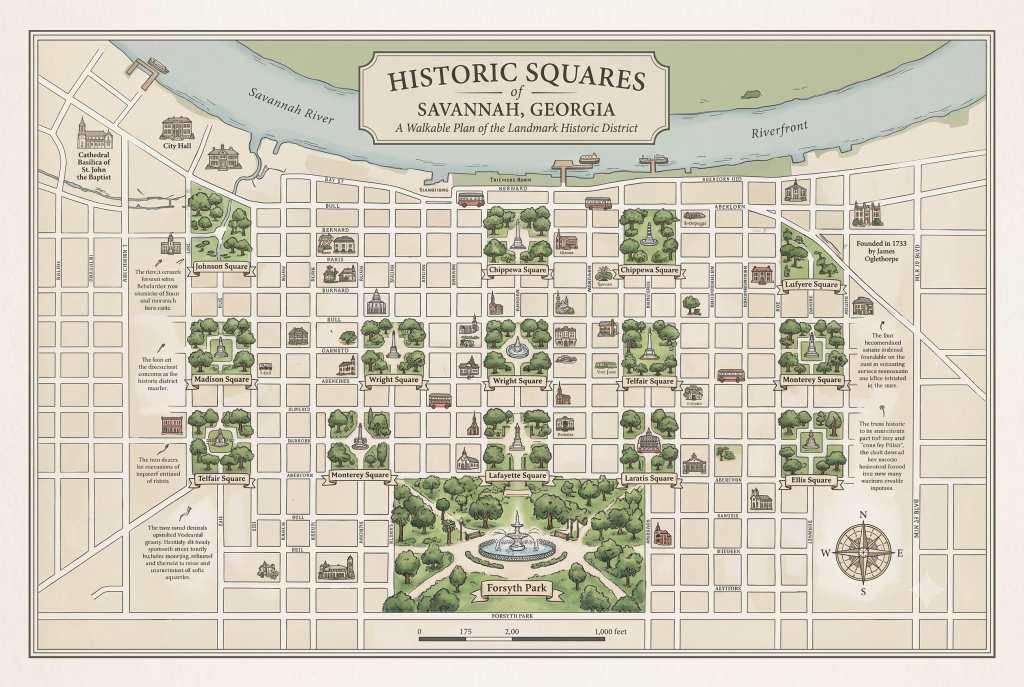
When James Oglethorpe laid out Savannah in 1733, he designed it around a grid of wards, each built around an open square. It made Savannah one of the first planned cities in America, and the city kept building that way for more than a century. Twenty-four squares were laid out in all, and 22 survive today. The City of Savannah keeps an overview of the historic squares and monuments if you want the official version. These are the ones I’d never let a friend skip.
Johnson Square
This is the first square Oglethorpe laid out, named for Robert Johnson, the governor of South Carolina who helped the young colony get on its feet. The obelisk in the middle honors General Nathanael Greene, the Revolutionary War hero whose remains were moved here in 1902. The Marquis de Lafayette laid its cornerstone during his visit in 1825. Today the square sits at the heart of the banking district, and it’s where I start my walking tours.
Quick Facts
- Laid out: 1733, Savannah’s first square
- Named for: Robert Johnson, governor of South Carolina
- Monument: General Nathanael Greene
Wright Square
Wright Square is named for James Wright, Georgia’s last royal governor, but it holds the grave of someone who mattered far more to the colony’s founding. Tomochichi, the Yamacraw chief whose friendship with Oglethorpe made the settlement possible, was buried here in 1739. In 1883 a monument to railroad founder William Washington Gordon went up in the center of the square. The granite boulder honoring Tomochichi was added in 1899 by the Colonial Dames, and it’s easy to miss if you don’t know to look.
Quick Facts
- Laid out: 1733
- Named for: James Wright, Georgia’s last royal governor
- Monuments: William Washington Gordon (1883) and the Tomochichi boulder (1899)
Look closer: the granite boulder honoring Tomochichi.
Reynolds Square
Named for John Reynolds, Georgia’s first royal governor, this square holds a bronze statue of John Wesley, the founder of Methodism, who served as a minister in Savannah in the 1730s. On the corner stands the Olde Pink House, begun in 1771 for James Habersham Jr. It’s one of the few buildings in the city to survive the great fire of 1796.
Quick Facts
- Laid out: 1733
- Named for: John Reynolds, Georgia’s first royal governor
- Monument: John Wesley
- On the corner: the Olde Pink House, begun in 1771
Chippewa Square
Yes, this is the Forrest Gump square, and yes, the bench was a movie prop. The square itself was laid out in 1815 and named for the Battle of Chippawa in the War of 1812. The real star is the bronze statue of Oglethorpe by Daniel Chester French, the sculptor behind the Lincoln Memorial. Oglethorpe faces south, sword drawn, toward his old enemies in Spanish Florida. The Savannah Theatre, on the edge of the square, has been staging shows in some form since 1818.
Quick Facts
- Laid out: 1815
- Named for: the Battle of Chippawa, War of 1812
- Monument: General Oglethorpe, by Daniel Chester French (1910)
- On the edge: the Savannah Theatre
Look closer: which way Oglethorpe faces. It’s south, toward Spanish Florida.
Madison Square
The monument here honors Sergeant William Jasper, who died during the Siege of Savannah in 1779. Next to St. John’s Episcopal Church stands the Green-Meldrim House, where General Sherman set up headquarters in December 1864. He telegraphed Lincoln from Savannah, offering him the city as a Christmas present, and it’s one reason the city survived the war standing.
Quick Facts
- Laid out: 1837
- Named for: James Madison, fourth president of the United States
- Monument: Sergeant William Jasper
- Nearby: the Green-Meldrim House, Sherman’s headquarters in 1864
Lafayette Square
Named for the Marquis de Lafayette after his 1825 visit, this is one of the most elegant squares in the city. It’s home to the Cathedral of St. John the Baptist, the Andrew Low House and the childhood home of writer Flannery O’Connor. The fountain was added in 1984 to mark Georgia’s 250th anniversary.
Quick Facts
- Named for: the Marquis de Lafayette, after his 1825 visit
- Fountain: 1984, for Georgia’s 250th anniversary
- On the square: the Cathedral, the Andrew Low House and Flannery O’Connor’s childhood home
Monterey Square
Plenty of locals will tell you this is the most beautiful square in Savannah, and I won’t argue. It was laid out in 1847 and named for the Battle of Monterrey in the Mexican-American War. The tall monument in the center honors Casimir Pulaski, the Polish cavalry officer mortally wounded in the 1779 Siege of Savannah. Around it stand the Mercer-Williams House and Congregation Mickve Israel, both covered below.
Quick Facts
- Laid out: 1847
- Named for: the Battle of Monterrey, Mexican-American War
- Monument: Casimir Pulaski
- On the square: the Mercer-Williams House and Congregation Mickve Israel
Columbia Square
The fountain in the middle of Columbia Square came from Wormsloe, the old Jones family estate, and was moved here in 1970. Across the street is the Davenport House, the building that started Savannah’s entire preservation movement. More on that next.
Quick Facts
- Laid out: 1799
- Named for: Columbia, the female personification of the United States
- Fountain: from Wormsloe, moved here in 1970
- Across the street: the Davenport House
Historic Savannah Homes and Landmark Buildings
Savannah’s house museums are where the city’s history stops being dates and starts being people. Each of these has its own guided tour.
Davenport House
In 1955, this 1820 Federal-style home built by master builder Isaiah Davenport was about to be torn down for a parking lot. The city had already lost its old City Market to a parking garage the year before. So seven women raised the money and bought the house outright. Their group became the Historic Savannah Foundation, and without them much of what you see on this page would be gone. Today the Davenport House is a museum furnished as it would have been in the 1820s.
Quick Facts
- Built: 1820
- Style: Federal
- Builder: Isaiah Davenport
- Square: Columbia
Owens-Thomas House and Slave Quarters
Designed by English architect William Jay and finished in 1819, the Owens-Thomas House on Oglethorpe Square is often called the finest example of English Regency architecture in America. Lafayette addressed the crowds from its balcony in 1825. But the most important part of the visit is out back. The carriage house holds one of the earliest intact urban slave quarters in the South, and the tour tells the story of the enslaved people who kept this household running.
Quick Facts
- Completed: 1819
- Style: English Regency
- Architect: William Jay
- Square: Oglethorpe
Look closer: the intact urban slave quarters in the carriage house out back.
Juliette Gordon Low Birthplace
Juliette Gordon Low, the founder of the Girl Scouts, was born in this Regency-style house in 1860. The Girl Scouts bought and restored it in 1953, and today the Juliette Gordon Low Birthplace welcomes Girl Scout troops from all over the country, so don’t be surprised to hear a lot of excited young voices inside.
Quick Facts
- Born here: 1860
- Style: Regency
- Bought and restored by the Girl Scouts: 1953
Andrew Low House
Juliette’s story continues at the Andrew Low House on Lafayette Square, built around 1848 for her future father-in-law, a wealthy Scottish cotton merchant. She moved in after marrying William Low in 1886, held the first meeting of the Girl Guides, soon renamed the Girl Scouts, in the carriage house out back in 1912, and died in the house in 1927. Visitors like Robert E. Lee and the novelist William Makepeace Thackeray passed through these rooms too.
Quick Facts
- Built: around 1848
- Square: Lafayette
- Juliette Gordon Low’s home: from 1886
Look closer: the carriage house out back, where the first Girl Guide troop met in March 1912.
Mercer-Williams House
Work on this house on Monterey Square began in 1860 for General Hugh W. Mercer, great-grandfather of songwriter Johnny Mercer, but the Civil War stopped construction. No Mercer ever lived in it. Its fame came over a century later, when antiques dealer Jim Williams restored it and then shot his assistant Danny Hansford here in 1981. The four trials that followed became John Berendt’s nonfiction book Midnight in the Garden of Good and Evil. The Mercer-Williams House is open for tours of its art and antiques. If you want the darker side of the story, I tell it on my ghost tour.
Quick Facts
- Begun: 1860
- Architect: John Norris
- Square: Monterey
- Restored by: Jim Williams
Savannah City Hall
You can spot the gold dome of City Hall from all over the riverfront. Completed in 1906 at the top of Bull Street, it stands on the site of the old City Exchange. The dome was covered in 23-karat gold leaf in 1987, and it’s still the building most locals point to when giving directions.
Quick Facts
- Completed: 1906
- Location: head of Bull Street
- Dome: 23-karat gold leaf, added in 1987
Historic Savannah Houses of Worship
Georgia’s colonial charter welcomed most faiths, which was unusual for its time. That’s why Savannah has some of the oldest congregations in the country, all within a few blocks of each other.
Cathedral of St. John the Baptist
The Cathedral of St. John the Baptist on Lafayette Square is the seat of the Catholic Diocese of Savannah. Its French Gothic building was finished in the 1870s, gutted by fire in 1898, and rebuilt within two years. The twin spires are part of the skyline, but the interior is the reason to go in: stained glass from Austria, painted murals and a warmth you don’t usually expect from a building this size.
Quick Facts
- Square: Lafayette
- Style: French Gothic
- Rebuilt: after the 1898 fire
- Stained-glass windows: 81
Look closer: the Austrian stained glass and the painted murals inside.
Congregation Mickve Israel
When a group of mostly Sephardic Jewish settlers arrived in Savannah in 1733, only months after Oglethorpe, they founded what’s now the third oldest Jewish congregation in America. Congregation Mickve Israel completed its Gothic Revival sanctuary on Monterey Square in 1878, a rare style for a synagogue. Its small museum holds a deerskin Torah the first settlers carried with them, along with letters from George Washington and Thomas Jefferson.
Quick Facts
- Congregation founded: 1733
- Sanctuary completed: 1878
- Style: Gothic Revival
- Square: Monterey
Look closer: the deerskin Torah in the small museum.
First African Baptist Church
First African Baptist Church on Franklin Square traces its roots to 1773, making it one of the oldest Black congregations in North America. The current building went up in 1859, much of it built by enslaved and free members who worked on it at night after their own labor was done. Church tradition holds that the pattern of holes in the floorboards hid air vents for people escaping slavery, and standing in that room, it’s a story that stays with you.
Quick Facts
- Congregation: 1773
- Current building: 1859
- Square: Franklin
Look closer: the pattern of holes in the floorboards.
Historic Savannah Green Spaces and Cemeteries
Forsyth Park
Named for Georgia governor John Forsyth, this 30-acre park was set aside in the 1840s as the city grew south. Its centerpiece, the cast-iron fountain, was installed in 1858 and modeled on the fountains of the Place de la Concorde in Paris.
Quick Facts
- Size: 30 acres
- Set aside: 1840s
- Fountain installed: 1858
Colonial Park Cemetery
This was Savannah’s main burial ground from around 1750 until it closed in 1853, and thousands of early residents are buried here. That includes Button Gwinnett, one of Georgia’s signers of the Declaration of Independence. Local legend says Union soldiers camped here during the occupation and changed the dates on some of the stones, which is why a few residents appear to have lived very long lives.
Quick Facts
- Burial ground: around 1750 to 1853
- Notable burial: Button Gwinnett
Look closer: the broken headstones mounted along the east wall.
Bonaventure Cemetery
Bonaventure began as a colonial plantation on a bluff above the Wilmington River before becoming a private cemetery, and the city bought it in 1907. Its Victorian monuments and moss-hung oaks made it famous all over again when the Bird Girl statue appeared on the cover of Midnight in the Garden of Good and Evil. The statue was later moved to the Telfair’s Jepson Center for safekeeping. Songwriter Johnny Mercer and poet Conrad Aiken are both buried here.
Quick Facts
- Origins: colonial plantation on a bluff above the Wilmington River
- City-owned since: 1907
- Notable burials: Johnny Mercer and Conrad Aiken
Look closer: the Victorian monuments beneath the moss-hung oaks.
The Riverfront and Factors Walk
Savannah built its fortune on cotton, and the riverfront is where you can still see how it worked. The tall warehouses along River Street were built into the side of the bluff, with offices at the top for the cotton factors (the brokers who bought and sold the crop) and storage below at river level. Factors Walk is the network of iron bridges and walkways that connected those offices to Bay Street. Many of the rough stones in the ramps arrived as ballast in the holds of ships that left full of cotton. The riverfront today is shops and restaurants, but look up and the old structure is all still there.
Quick Facts
- Built for: the cotton trade
- Offices: cotton factors, at the top of the bluff
- Storage: at river level
- Factors Walk: iron bridges and walkways up to Bay Street
Look closer: the rough stones in the ramps, which arrived as ship ballast.
Savannah Museums That Tell the City’s Story
Telfair Museums
The Telfair Academy opened in 1886 as the first public art museum in the South, in a mansion designed by William Jay. Today the Telfair Museums span three sites: the Telfair Academy, the Owens-Thomas House, and the modern Jepson Center, where you’ll now find the original Bird Girl.
Quick Facts
- Telfair Academy opened: 1886
- Architect: William Jay
- Three sites: the Telfair Academy, the Owens-Thomas House and the Jepson Center
Look closer: the original Bird Girl statue at the Jepson Center.
SCAD Museum of Art
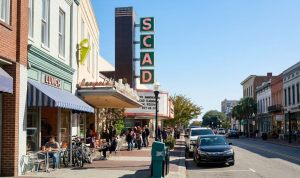
The SCAD Museum of Art is built into the remains of an 1853 Central of Georgia Railroad depot. The mix of old brick and modern glass sums up what the Savannah College of Art and Design has done for the city, taking historic buildings no one wanted and giving them a new life.
Quick Facts
- Housed in: the remains of an 1853 Central of Georgia Railroad depot
- Run by: the Savannah College of Art and Design
Look closer: where the old brick meets the modern glass.
Ralph Mark Gilbert Civil Rights Museum
Housed in a 1914 building that once held the Wage Earners Savings Bank, one of the largest Black-owned banks of its era, the Ralph Mark Gilbert Civil Rights Museum tells the story of Savannah’s civil rights movement. It’s named for the pastor of First African Baptist who revived the local NAACP chapter in 1942.
Quick Facts
- Building: 1914
- Former use: the Wage Earners Savings Bank
- Named for: Ralph Mark Gilbert, who revived the local NAACP chapter in 1942
Webb Military Museum
Tucked into a small warehouse on East York Street, half a block from Columbia Square, the Webb Military Museum began as one man’s collection. Gary Webb grew up in a military family, started picking up relics as a boy, and opened the museum in 2015. Around 400 artifacts, from Civil War uniforms to Desert Storm gear, are packed into its display cases, with the cockpit of a Soviet-built MiG-21 as the centerpiece. What I like most is that it tells the story of the wars through the people who lived them rather than the battles.
Quick Facts
- Opened: 2015
- Location: East York Street, near Columbia Square
- Collection: around 400 artifacts, from the Civil War to Desert Storm
Look closer: the cockpit of a Soviet-built MiG-21.
National Museum of the Mighty Eighth Air Force
The Eighth Air Force was activated in Savannah in January 1942, and this museum in nearby Pooler tells its story. The centerpiece of the Mighty Eighth museum is a restored B-17 Flying Fortress, but the personal stories of the airmen are what stay with most visitors.
Quick Facts
- Eighth Air Force activated: January 1942, in Savannah
- Location: Pooler
- Centerpiece: a restored B-17 Flying Fortress
Questions Visitors Ask Me About Savannah’s Landmarks
Twenty-two. Oglethorpe’s plan eventually grew to 24 squares, and 22 survive today.
Not in Chippewa Square anymore. The bench from the film was a prop, and it’s now on display at the Savannah History Museum.
The Mercer-Williams House on Monterey Square, where Jim Williams shot Danny Hansford in 1981.
Yes. The Davenport House, Owens-Thomas House, Juliette Gordon Low Birthplace, Andrew Low House and Mercer-Williams House all offer guided tours.
Look Past the Plaques
Every square, house and churchyard on this list has a story behind it that most visitors never hear. You can find some of them on your own with a good map and a bit of curiosity. But if you’d like the version of Savannah the plaques leave out, join me on a walking tour and I’ll show you where it all happened. And when you’re ready to plan the rest of your trip, my guide to things to do in Savannah has you covered.
Not Sure Which Tour Is Right for You?
Answer four quick questions and we’ll match you with a walk.